

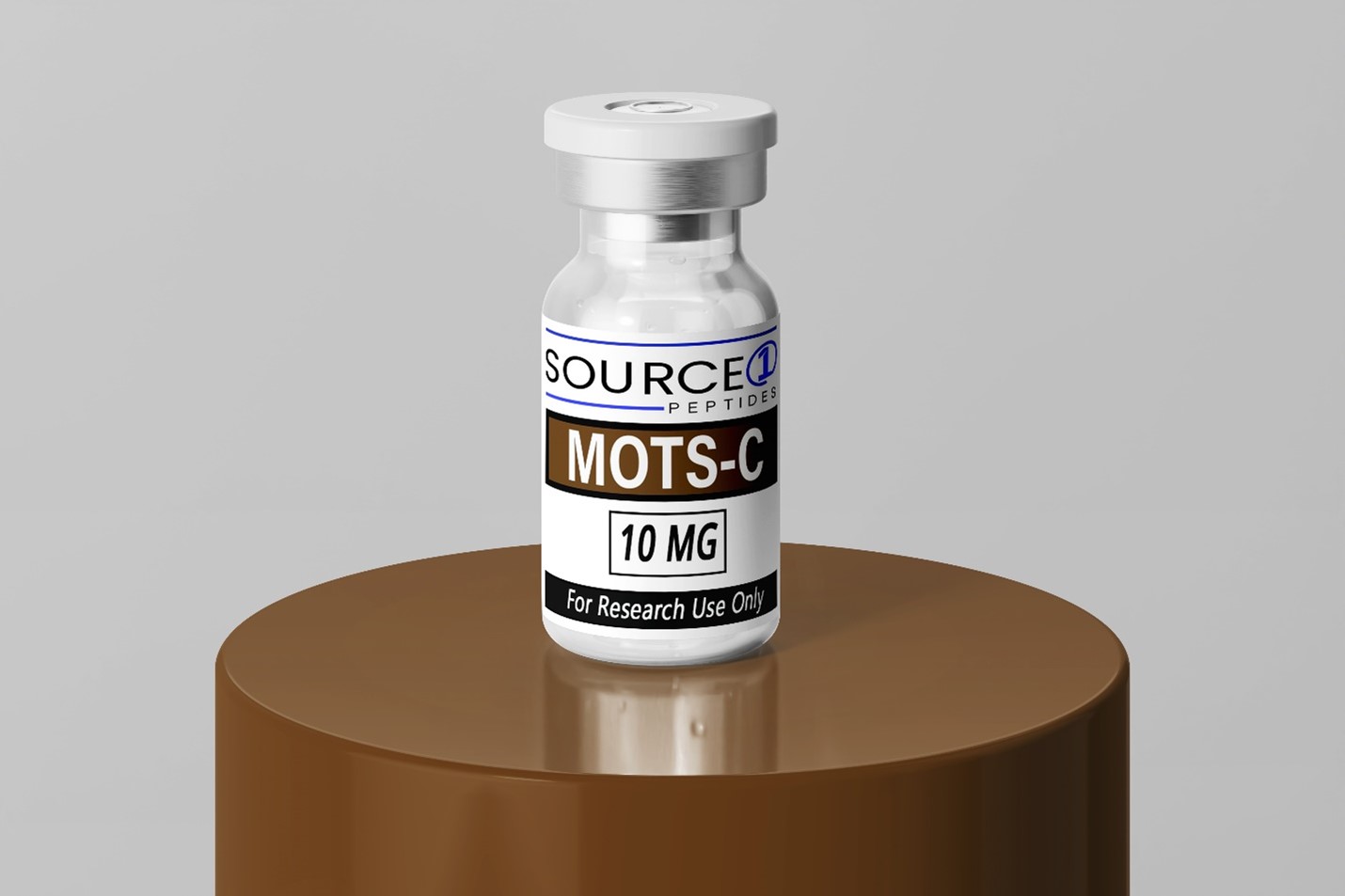
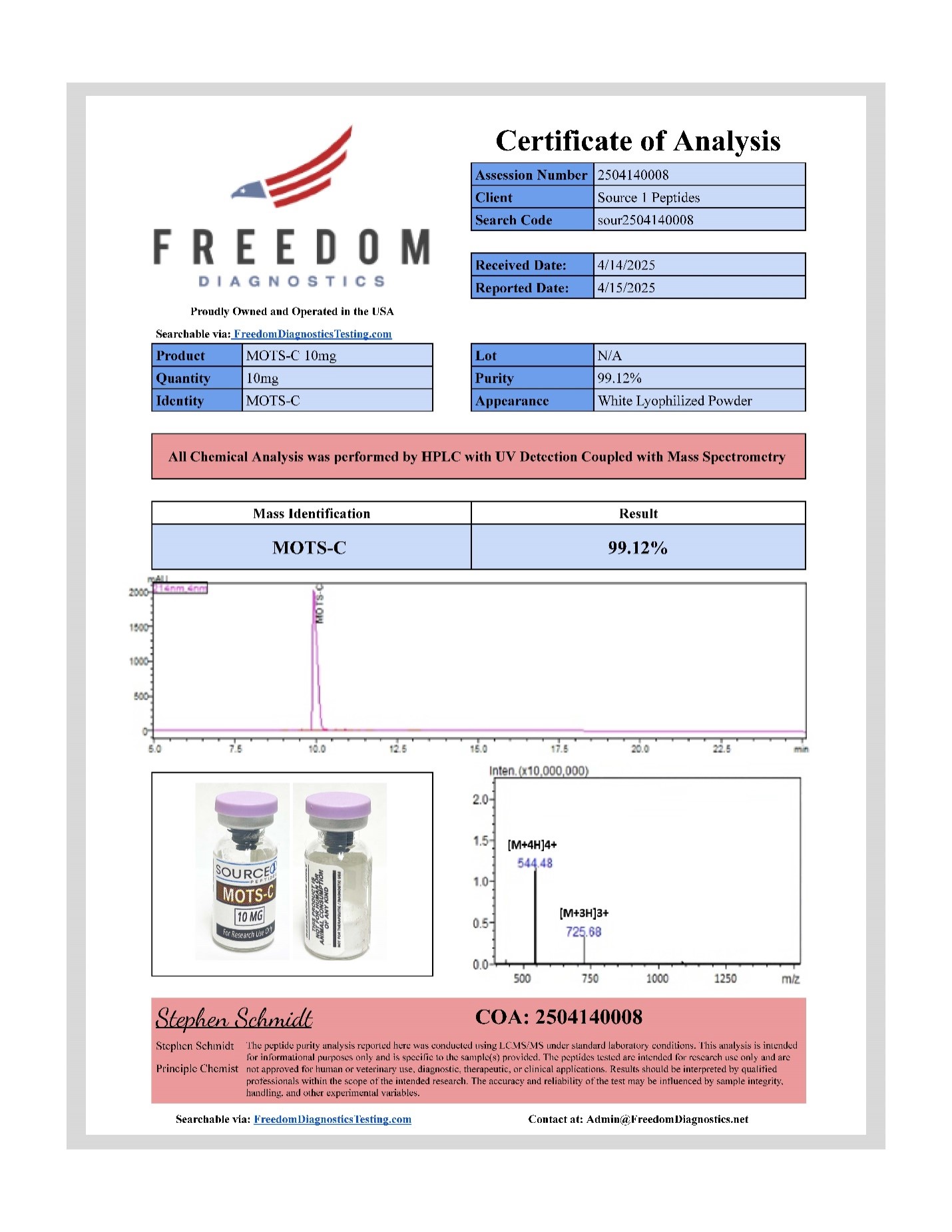
$49.00
MOTS-c is a mitochondrial-derived peptide composed of 16 amino acids, encoded by the 12S rRNA region of the mitochondrial genome. It plays significant roles in metabolic homeostasis, nuclear gene expression, and has potential therapeutic applications for metabolic dysfunction, insulin sensitivity and age-related diseases.
84 in stock
MOTS-c is a mitochondrial-derived peptide composed of 16 amino acids, encoded by the 12S rRNA region of the mitochondrial genome. It plays significant roles in metabolic homeostasis, nuclear gene expression, and has potential therapeutic applications for metabolic dysfunction, insulin sensitivity and age-related diseases.
MOTS-c (Mitochondrial Open Reading Frame of the 12S rRNA-c) is a mitochondria-derived peptide discovered in 2015 that functions as a mitochondrial-encoded regulatory signal. The 16-amino acid peptide is encoded by the mitochondrial genome within the 12S rRNA gene and represents an important link between mitochondrial function and metabolism. MOTS-c primarily targets skeletal muscle and acts as a metabolic regulator by activating the AMPK (AMP-activated protein kinase) pathway, which is crucial for cellular energy homeostasis.
Research Areas:
Metabolic Regulation
Cognitive Function
Neuroprotection
Muscle Homeostasis
Longevity
MOTS-c and Metabolic Regulation
MOTS-c translocates to the nucleus in response to metabolic stress, where it regulates nuclear gene expression. This process is AMPK-dependent and involves interaction with stress-responsive transcription factors, such as NRF2, to modulate genes associated with antioxidant responses and glucose metabolism1.
MOTS-c activates the AMPK pathway, which is crucial for energy balance and metabolic regulation. This activation helps improve insulin sensitivity and energy dissipation, particularly in conditions like ovariectomy-induced metabolic dysfunction2.
MOTS-c has been shown to prevent diet-induced obesity and insulin resistance by enhancing glucose metabolism and targeting skeletal muscle. It inhibits the folate cycle, leading to AMPK activation, which is essential for maintaining metabolic homeostasis3.
In postmenopausal models, MOTS-c treatment reduces fat mass, suppresses inflammatory responses, and sustains brown adipose tissue activity, thereby preventing weight gain and insulin resistance2.
Cognitive Decline and Neuroprotection
MOTS-c has demonstrated significant anti-inflammatory properties, which are crucial for neuroprotection. It inhibits the activation of astrocytes and microglia, reducing the production of proinflammatory cytokines such as TNF-α, IL-6, IL-1β, COX-2, and iNOS4. This reduction in neuroinflammation is associated with improved cognitive functions and memory in models of Alzheimer’s disease (AD) and traumatic brain injury (TBI)5.
The peptide enhances metabolic processes, including lipid β-oxidation, which provides energy to the brain following injury. This metabolic support is vital for maintaining brain function and reducing molecular damage and cell death in TBI models4.
MOTS-c has been shown to enhance object and location recognition memory. It improves memory formation and consolidation, which are critical for cognitive function. These effects are particularly evident in models of AD and TBI, where MOTS-c administration leads to significant improvements in memory tasks5.
Continued research is needed to fully understand the mechanisms by which MOTS-c exerts its neuroprotective effects and to optimize its delivery methods for clinical applications. This includes exploring its role in other neurodegenerative conditions and refining its use as a therapeutic agent.
Muscle Homeostasis and Physical Decline
MOTS-c enhances skeletal muscle metabolism by regulating nuclear genes related to metabolism and proteostasis. It also aids myoblast adaptation to metabolic stress, which is crucial for maintaining muscle function and preventing atrophy6.
MOTS-c treatment in mice has been shown to significantly enhance physical performance across different age groups, including young, middle-aged, and old mice. This suggests its potential in mitigating age-related physical decline6.
MOTS-c has been shown to prevent muscle atrophy by reducing myostatin levels, a negative regulator of muscle mass. This effect is mediated through the PTEN/AKT/FOXO1 signaling pathway, which is crucial for muscle growth and maintenance7.
In humans, exercise induces the expression of MOTS-c in skeletal muscle and circulation, indicating its role as an exercise-induced regulator of physical capacity and metabolic homeostasis6.
MOTS-c shows promise as a therapeutic agent for conditions like sarcopenia and insulin resistance-induced muscle atrophy. Its ability to modulate key signaling pathways and reduce inflammatory cytokines highlights its potential in treating muscle wasting phenotypes7.
Longevity and Anti-Aging
MOTS-c holds significant promise as a therapeutic agent for promoting longevity and combating age-related decline. Its ability to regulate metabolic processes, enhance physical performance, and potentially treat age-related diseases positions it as a valuable target for future research and clinical applications in anti-aging therapies8.
A specific polymorphism in the MOTS-c encoding region has been linked to exceptional longevity in certain populations, suggesting a genetic basis for its anti-aging effects9.
References
Kim, K., Son, J., Benayoun, B., & Lee, C. (2018). The Mitochondrial-Encoded Peptide MOTS-c Translocates to the Nucleus to Regulate Nuclear Gene Expression in Response to Metabolic Stress.. Cell metabolism, 28 3, 516-524.e7 . https://doi.org/10.1016/j.cmet.2018.06.008.
Lu, H., Wei, M., Zhai, Y., Li, Q., Ye, Z., Wang, L., Luo, W., Chen, J., & Lu, Z. (2019). MOTS-c peptide regulates adipose homeostasis to prevent ovariectomy-induced metabolic dysfunction. Journal of Molecular Medicine, 97, 473 – 485. https://doi.org/10.1007/s00109-018-01738-w.
Lee, C., Zeng, J., Drew, B., Sallam, T., Martín-Montalvo, A., Wan, J., Kim, S., Mehta, H., Hevener, A., De Cabo, R., & Cohen, P. (2015). The mitochondrial-derived peptide MOTS-c promotes metabolic homeostasis and reduces obesity and insulin resistance.. Cell metabolism, 21 3, 443-54 . https://doi.org/10.1016/j.cmet.2015.02.009.
Li, F., Jia, Y., Fang, J., Gong, L., Zhang, Y., Wei, S., Wu, L., & Jiang, P. (2024). Neuroprotective Mechanism of MOTS-c in TBI Mice: Insights from Integrated Transcriptomic and Metabolomic Analyses. Drug Design, Development and Therapy, 18, 2971 – 2987. https://doi.org/10.2147/DDDT.S460265.
Jiang, J., Chang, X., Nie, Y., Shen, Y., Liang, X., Peng, Y., & Chang, M. (2021). Peripheral Administration of a Cell-Penetrating MOTS-c Analogue Enhances Memory and Attenuates Aβ1-42- or LPS-Induced Memory Impairment through Inhibiting Neuroinflammation.. ACS chemical neuroscience. https://doi.org/10.1021/acschemneuro.0c00782.
Reynolds, J., Lai, R., Woodhead, J., Joly, J., Mitchell, C., Cameron-Smith, D., Lu, R., Cohen, P., Graham, N., Benayoun, B., Merry, T., & Lee, C. (2021). MOTS-c is an exercise-induced mitochondrial-encoded regulator of age-dependent physical decline and muscle homeostasis. Nature Communications. https://doi.org/10.1038/s41467-020-20790-0.
Kumagai, H., Coelho, A., Wan, J., Mehta, H., Yen, K., Huang, A., Zempo, H., Fuku, N., Maeda, S., Oliveira, P., Cohen, P., & Kim, S. (2021). MOTS-c reduces myostatin and muscle atrophy signaling.. American journal of physiology. Endocrinology and metabolism. https://doi.org/10.1152/ajpendo.00275.2020.
Mohtashami, Z., Singh, M., Salimiaghdam, N., Ozgul, M., & Kenney, M. (2022). MOTS-c, the Most Recent Mitochondrial Derived Peptide in Human Aging and Age-Related Diseases. International Journal of Molecular Sciences, 23. https://doi.org/10.3390/ijms231911991.
Fuku, N., Pareja-Galeano, H., Zempo, H., Alis, R., Arai, Y., Lucia, A., & Hirose, N. (2015). The mitochondrial‐derived peptide MOTS‐c: a player in exceptional longevity?. Aging Cell, 14, 921 – 923. https://doi.org/10.1111/acel.12389.
Research Use Only – Important Disclaimer
This product is intended strictly for research purposes only. It is designated exclusively for in vitro testing and laboratory experimentation by licensed, qualified professionals. All product information provided on this website is for educational and informational purposes only. These products are not intended for human or animal use under any circumstances. They must not be used as food, drugs, cosmetics, or administered in any way to living organisms. Any use that constitutes misbranding, misuse, mislabeling, or purposes outside of scientific research is strictly prohibited. Product Handling and Presentation All products are supplied in lyophilized (freeze-dried) powder form, sealed in sterile vials. Each vial is clearly labeled with its exact contents, and certain products may be available in multiple quantity variations.
These products require proper laboratory equipment for safe reconstitution and testing, which may include but is not limited to: Bacteriostatic water Syringes and needles (for handling and reconstitution) Alcohol preparation pads While we make every effort to ensure that packaging, labeling, and product appearance match the images shown on our website, minor deviations may occur.
Legal and Regulatory Notes By purchasing from our website, you confirm that you are a licensed and qualified professional who understands the proper handling protocols, safety measures, and limitations associated with research chemicals
FDA Disclaimer: The products and information provided on this website have not been evaluated by the FDA. These products are not intended to diagnose, treat, cure, or prevent any disease or health condition. Key Classification Information Peptides and other research chemicals sold on this site are not recognized as dietary supplements.
These substances are classified strictly as research chemicals—intended solely for scientific or medical research in controlled laboratory environments. They are not intended for human or veterinary use, nor for any kind of bodily introduction.
These products are exempt from specific regulations under Title 21, Parts 100–740 of the Code of Federal Regulations (21 CFR), as clearly noted on their labeling. 🚫 NOT SUITABLE FOR
HUMAN CONSUMPTION INTENDED FOR RESEARCH USE ONLY
The statements made within this website have not been evaluated by the US Food and Drug Administration. The statements and the products of this company are not intended to diagnose, treat, cure or prevent any disease. Source1Peptides is a chemical supplier. Source1Peptides is not a compounding pharmacy or chemical compounding facility as defined under 503A of the Federal Food, Drug, and Cosmetic act. Source1Peptides is not an outsourcing facility as defined under 503B of the Federal Food, Drug, and Cosmetic act. All products are sold for research, laboratory, or analytical purposes only, and are not for human consumption.


Reviews
There are no reviews yet.